
MIGRANT FORUM IN ASIA (MFA) believes that migrants’ rights are human rights. Documented or undocumented, irrespective of race, gender, class, age and religious belief, migrant workers’ rights are guaranteed by the UN Declaration of Human Rights, the UN Convention on the Protection of Rights of All Migrant Workers and Members of their Families and other international conventions.
MFA is a regional network of non-government organizations (NGOs), associations and trade unions of migrant workers, and individual advocates in Asia who are committed to protect and promote the rights and welfare of migrant workers.

Programs and Campaigns
Featured Member
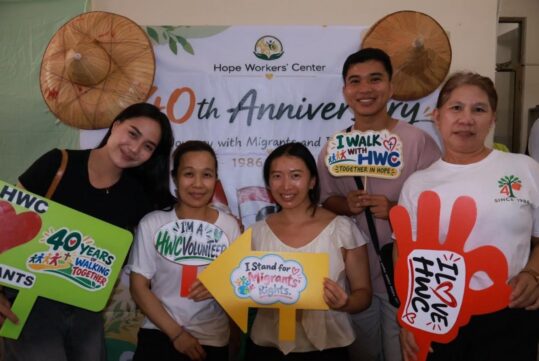
Hope Workers Center
A founding member of Migrant Forum in Asia, Hope Workers Center in Chugli, Taiwan works to educate & assist migrants on their rights & lobby the government for fair employment conditions.
Statements
Today, on International Migrants Day, Migrant Forum in Asia (MFA) celebrates the contributions made by millions of migrants all over the world and calls on the global community to respect the human rights and dignity of migrant workers and members of their families!
More than 214 million people worldwide are migrants – living, working, raising families and building communities in places outside their countries of origin. The contributions of migrants are vast and multifaceted, with their hard work, dedication and creativity supporting the social, economic and cultural foundations of societies around the world. Countries have prospered as migrant workers have built their national infrastructure and fuelled the engines of their economies.
It is also a feat that in 2012, Indonesia became the 46th State to ratify the International Convention on the Protection of the Rights of Migrant Workers and Members of their Families (UN 1990 MWC). We will not tire and falter in our ratification campaign until all States ratify and implement the Convention.
While today should be a celebratory occasion on the achievements of and for migrant workers, let us also be reminded of the persistent challenge of the global economic downturn that creates a climate of instability, precarious work and continuing struggles of migrant workers and members of their families. Vulnerable groups including migrant workers are strongly affected by these economic shocks. While they are already discriminated because of their status, their discrimination is increased in times of fiscal crisis. Often they are blamed for causing the instability of the economy and society. This situation calls for a comprehensive approach that not only addresses the working conditions of migrant workers but also of local workers in migrant receiving countries. Instead of pitting migrant and local workers against each other, we should strike at the systemic roots of inequality that promote social and economic injustice.
Publications